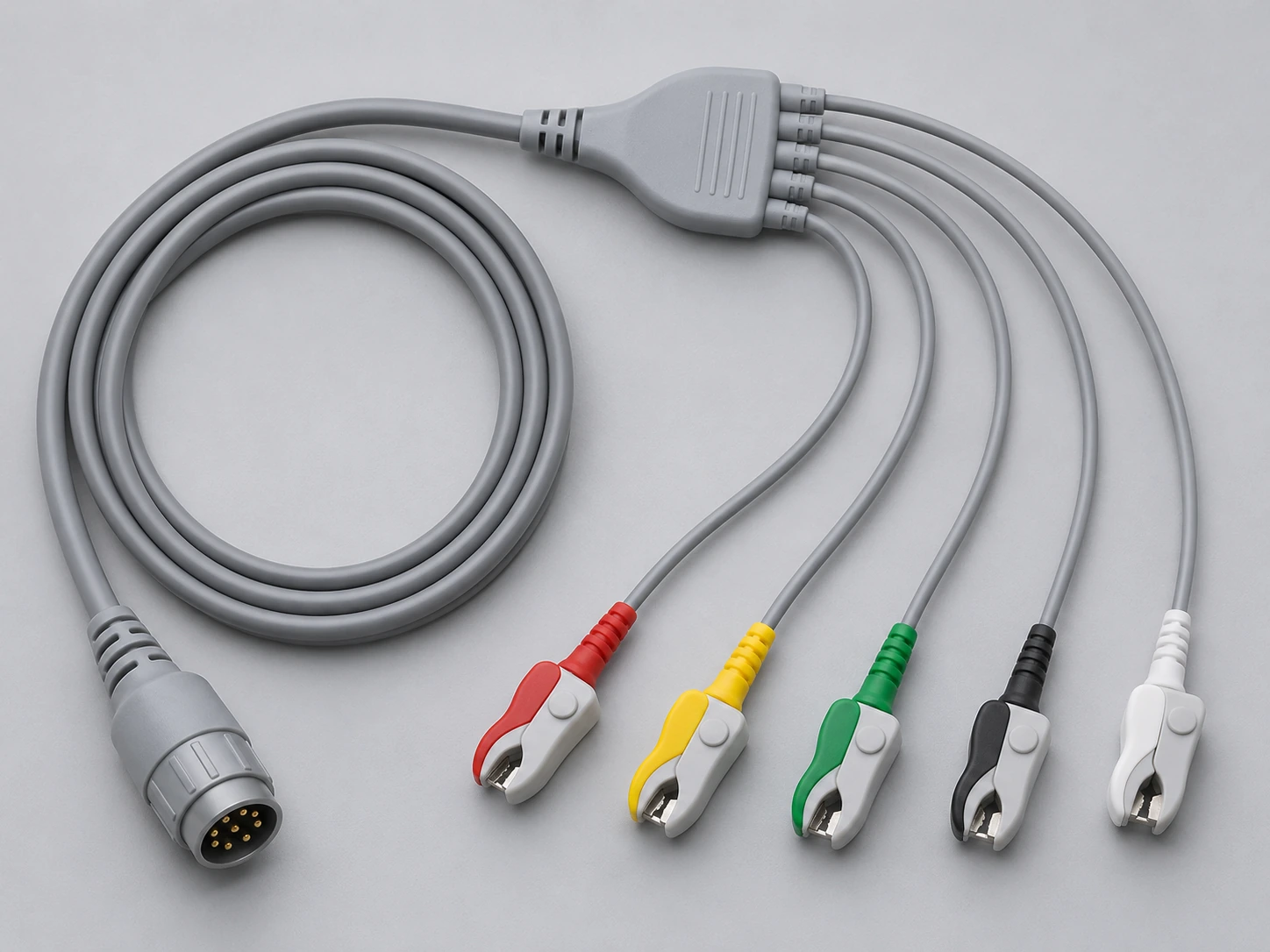
01 What defines an ECG cable
- Lead configuration — 3, 5, 6 or 12 lead, and the electrode type.
- Cable architecture — trunk with leadwires, or a single molded run.
- Device interface — connector type, pin assignment and keying.
- Identification — color coding and marking that match your protocol.
02 Where ECG assemblies fail
Most field failures are mechanical, not electrical. The leadwire breaks where it enters the electrode clip; the trunk fails at the strain relief. Both are decided at design review, not at inspection.
- Leadwire junction at the clip — the highest flex concentration.
- Trunk strain relief at the device connector.
- Shielding continuity where the cable is repeatedly coiled.
- Legibility of color coding after repeated cleaning.
03 Project data we need
- Lead configuration and electrode compatibility.
- Trunk length, lead length and tolerance.
- Connector part number and pinout drawing.
- Labeling protocol, including language requirements.
- Whether defibrillation or electrosurgery exposure applies.
Defibrillation protection and patient-safety performance depend on the complete device, including the electrode and monitor. Those claims belong to the device maker, not to the cable supplier.